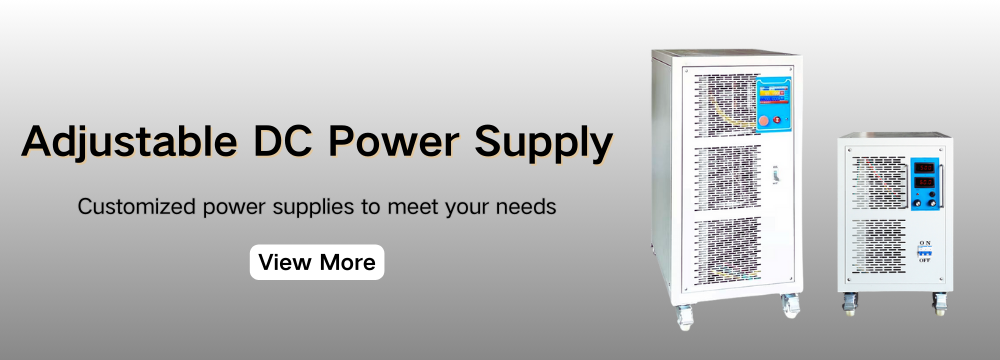
Water treatment is a fundamental infrastructure requirement for urban operations and industrial production, and is also a recognized high-energy-consuming scenario. Core processes such as aeration, mixing, pressurization, electrolysis, and disinfection have long relied on fixed power supplies and industrial frequency drives, resulting in high energy consumption, inefficient control, significant equipment wear and tear, high maintenance costs, and unstable treatment effects. Under the industry trend towards low-carbon, intelligent, and intensive systems, adjustable power supply solutions, with their advantages of precise adaptation, high efficiency and energy saving, stability and reliability, and intelligent linkage, are rapidly becoming the mainstream upgrade direction for water plants, wastewater treatment plants, and circulating water treatment systems, driving the industry from "extensive power supply" to "precise energy supply."
I. Precisely Matching Operating Fluctuations, Stable Ensuring Water Treatment Effects
Water treatment loads shift constantly with water quality, flow, and operating time, making conventional power supplies unable to meet real-time demands. Fixed-output units often cause over/under-aeration, unstable pressure, and inconsistent electrolysis efficiency, leading to substandard effluent quality.
Adjustable power supplies, however, allow continuous regulation of voltage, current, frequency, and power, accurately matching pressurized delivery, electrolytic disinfection, and UV sterilization processes to keep operations at optimal levels.
High output stability and pure waveform prevent grid fluctuations from interfering with equipment operation, significantly improving effluent consistency and compliance rates.
II. High Efficiency, Energy Saving, and Cost Reduction: Solving the Pain Points of High-Energy-Consuming
Industries Electricity consumption accounts for a very high proportion of operating costs in the water treatment industry; energy saving directly determines profitability.
Fixed power supply equipment often operates under conditions of insufficient power, wasting a significant amount of energy through throttling and heat generation.
Adjustable power supply boasts high conversion efficiency and a superior power factor, outputting energy on demand, eliminating ineffective losses, and achieving a comprehensive energy saving rate of 20%–40%.
Long-term operation can significantly reduce electricity costs while minimizing investment in cooling systems, achieving "less power consumption, more water output, and lower cost."
III. Flexible Adaptability to Multiple Processes: One Machine Covers All Scenarios Modern
Water treatment processes are diverse, placing higher demands on power supply compatibility.Adjustable power supplies offer multiple operating modes—constant voltage, constant current, constant power, and pulse output—making them highly compatible with various loads. Their wide adjustment range enables stable operation under diverse conditions, including water quality variations, seasonal changes, and system expansion or renovation projects, reducing the need for frequent equipment replacements and improving overall asset utilization.
IV. Extended Equipment Lifespan and Reduced Operating and Maintenance Costs
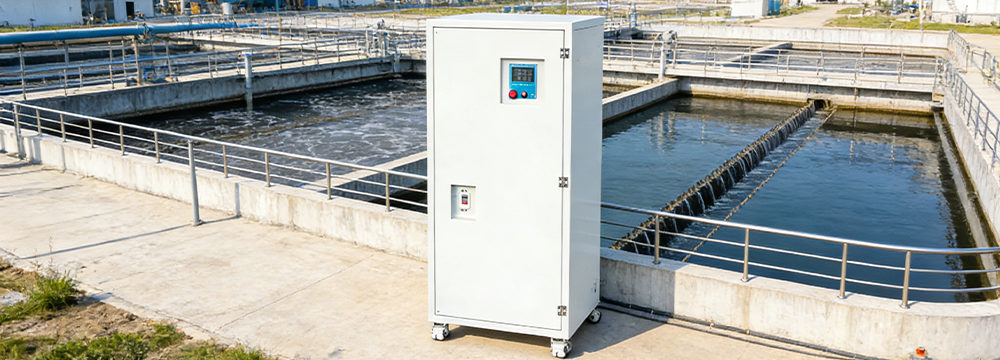
Water treatment facilities often work under harsh conditions—high temperature, humidity, and corrosive gases—placing high demands on equipment stability.Adjustable power supplies use soft start/stop to avoid large current surges that speed up aging in motors, pumps, and electrodes.Full built-in protections (overcurrent, overvoltage, overheat, short circuit, phase loss, reverse current) greatly lower failure and downtime risks.
Less wear, longer service life, and fewer breakdowns cut maintenance, replacement, and downtime losses, keeping production running steadily.
V. Supporting Intelligent Linkage and Facilitating Smart Water Management Upgrades
Adjustable power supply is naturally suited to the needs of automation and digital transformation.
It supports communication methods such as RS485, PLC, and remote networking, enabling linkage with central control systems to achieve fully automatic adjustment, data monitoring, and anomaly alarms.
On-demand adjustment and unattended operation reduce manual operation and intervention, improving the intelligence level of water plants.
It facilitates integration with energy management platforms, helping enterprises achieve carbon footprint monitoring and green certification.
The core reason why adjustable power supply solutions have become the preferred upgrade option in the water treatment industry is that they achieve precise power supply, efficient operation, adaptability to operating conditions, extended equipment lifespan, and intelligent management. It not only solves the pain points of high energy consumption, coarse control, and poor stability of traditional fixed power supplies, but also stabilizes effluent quality, reduces operating costs, extends equipment lifespan, and supports the construction of smart water management systems.
With increasingly stringent water resource management and the advancement of low-carbon policies, adjustable power supply will transform from an "optional configuration" to a "standard necessity," continuously providing core driving force support for improving quality, efficiency, carbon reduction, and cost reduction in the water treatment industry.