Anodizing is widely used in the manufacturing of aluminum alloy profiles, automotive parts, and 3C electronic casings, and is a core method for improving the hardness, corrosion resistance, and aesthetics of metal surfaces. As the core power equipment for this process, the energy efficiency of the anodizing power supply directly determines the electricity costs and carbon emission indicators of manufacturing enterprises. Practice shows that, under similar hardware configurations and process parameters, the selection and optimization of the topology is the decisive factor in achieving anodizing power supply energy efficiency exceeding 90% and realizing reduced consumption and increased efficiency. It determines the magnitude of the conversion loss from obtaining power from the grid to outputting it to the load, and also determines the stability and heat control level of the equipment under high load and long-term operation.
I. Core Bottleneck: Why Traditional Topologies Struggle to Overcome Energy Efficiency Bottlenecks
In the early stages of anodizing power supply development, linear power supplies and early phase-controlled power supplies dominated the market, but they generally faced the bottleneck of low energy efficiency.
Linear power supplies regulate voltage by adjusting the voltage drop across transistors, which basically turns extra energy into heat. Their efficiency is usually only 50% to 60%, so nearly half the power is wasted as heat. This not only raises operating costs but also requires more installation space because of the bulky cooling system. While phase-controlled power supplies address some efficiency issues through thyristor-controlled voltage regulation, they suffer from low power factor, high harmonic content, and slow dynamic response. Their efficiency usually hovers between 75%-80%, and they are bulky and noisy.
Both of these traditional topologies share the pain point of high energy loss and low power factor during energy conversion. For anodizing production lines that operate at hundreds of kilowatts continuously for 24 hours, this inefficient energy conversion mode is akin to "snatching food from a tiger's mouth," severely compressing profit margins and becoming a core pain point in industrial energy-saving renovations.
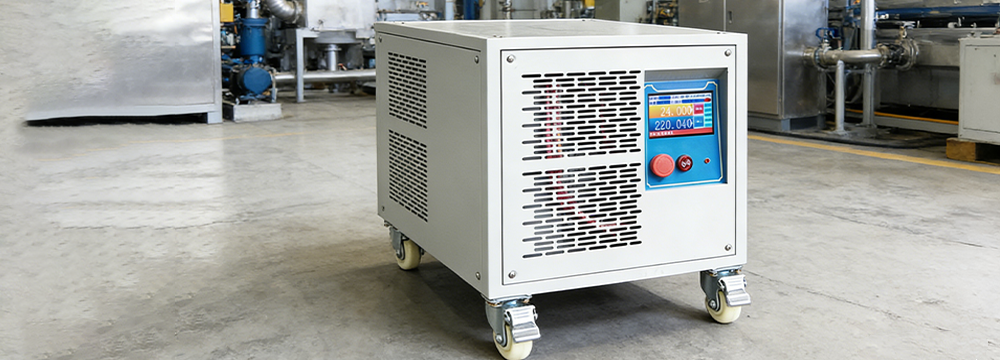
II. Core Key: High-Frequency Soft-Switching Topology Reconstructs Energy Efficiency Boundaries
With the development of power electronics technology, the application of phase-shifted full-bridge topology and LLC resonant topology has completely reconstructed the energy efficiency landscape of anodizing power supplies, becoming the core key to improving energy efficiency.
First, there is the revolution of "low loss." In traditional hard-switching topologies, the switching devices generate huge voltage and current overlaps at the moment of conduction and turn-off, resulting in significant switching losses. The LLC resonant topology, however, achieves zero-voltage turn-on (ZVS) and zero-current turn-off (ZCS) of the switching devices through a resonant circuit. This means that there is almost no energy loss during switching, reducing switching losses to negligible levels. This technological breakthrough directly increases the full-load energy efficiency of the power supply from 80% to over 90%, with some high-end models even reaching 93%-95%.
Second, there is the support of "high power density." Anodizing power supplies typically require high power output. To reduce losses, traditional topologies have to increase the size of magnetic components such as transformers and inductors, resulting in bulky equipment. LLC and phase-shifted full-bridge topologies, due to their high efficiency, allow operation at higher switching frequencies. Higher frequencies significantly reduce the size and weight of magnetic components, achieving the same high power output while reducing equipment size and weight, lowering material costs and improving space utilization.
Furthermore, there is the purification of "low harmonics." Anodizing loads are typically nonlinear and have high requirements for grid stability. Optimized topologies combined with advanced PFC (Power Factor Correction) technology can significantly improve the power factor to above 0.99 and greatly reduce harmonic pollution. This not only reduces interference to the grid and avoids the risk of penalties but also ensures a clean voltage waveform and improves the quality and stability of the oxide film layer.
III. Scenario Empowerment: How Topologies Adapt to Process Requirements
Beyond basic energy efficiency, the advancement of the topology directly determines whether the power supply can perfectly adapt to the complex process conditions of anodizing, thereby indirectly achieving "hidden efficiency gains."
First, precise matching of pulse and DC requirements. Anodizing processes often require rapid switching between DC, pulse, and square wave modes. High-performance topologies possess extremely fast dynamic response speeds, enabling millisecond-level parameter switching to ensure smooth voltage and current transitions and avoid increased product defect rates due to process fluctuations.
Secondly, they overcome the challenges of high reliability and heat dissipation. The anodizing environment is complex, with dust, high temperatures, and humidity being commonplace. The high-efficiency topology itself generates less heat, reducing reliance on powerful air or water cooling, lowering the risk of fan wear and dust inhalation, and also reducing PCB thermal stress, thus extending the equipment's lifespan in the field.
In summary, topology is the core variable and upper limit bottleneck for improving the energy efficiency of anodizing power supplies. From traditional inefficient linear and phase-controlled topologies to modern high-efficiency LLC and phase-shifted full-bridge topologies, each technological leap has brought at least a 10-15 percentage point improvement in energy efficiency. For manufacturing companies, the choice of power supply topology is not merely a difference in electricity costs, but a decisive factor in product yield, equipment lifespan, and the level of green manufacturing.
In the future, with the deep integration of wide-bandgap semiconductors (GaN/SiC) and novel topologies, the energy efficiency of anodizing power supplies will further break through limitations, developing towards higher efficiency, higher power density, and greater intelligence. Mastering the core topology technology means holding the key to the green and low-carbon transformation of the anodizing industry.