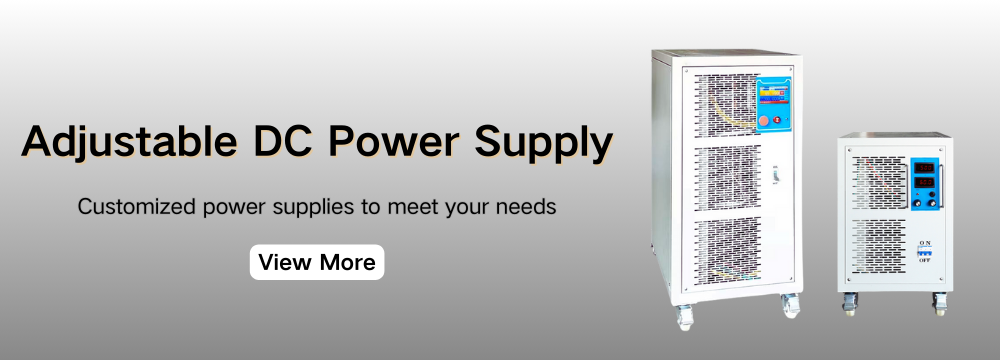
With growing water scarcity and stricter environmental standards, the water treatment industry is rapidly moving toward higher efficiency, energy savings, and intelligence. Electric-driven technologies including electrolytic disinfection, electrocoagulation, and electrocatalytic oxidation are now widely used in drinking water purification and wastewater treatment. As the core power and control equipment, adjustable power supplies directly affect treatment efficiency, effluent quality, and energy consumption through their precision, control performance, and operational stability. Unlike conventional fixed power supplies, they can flexibly adjust output voltage, current, and frequency based on actual water quality and process conditions, optimizing the reaction system at the source.
I. Core Logic: Adjustable Power Supplies Adapt to the Dynamic Needs of Water Treatment Processes
The core pain point of water treatment processes lies in the fluctuation of water quality and quantity—the concentration of pollutants, pH value, and conductivity vary significantly at different times and from different water sources, and the demand for power supply parameters also changes accordingly. Traditional fixed power supplies have limited output parameters and cannot adapt to dynamic operating conditions, easily leading to incomplete reactions, energy waste, or substandard treatment results. Adjustable power supplies, through precise control of output parameters, achieve "condition-adaptive power supply," with core advantages in two aspects: first, continuously adjustable voltage and current to match the energy demands of different reaction stages; second, support for multiple modes such as high-frequency pulses and polarity reversal, optimizing electrode reaction efficiency and reducing side reactions, thereby promoting efficient operation of the water treatment process. This is the core logic behind its improved treatment efficiency.
II. Process-Specific Quantification: The Efficiency Improvement of Adjustable Power Supplies
The efficiency improvement of adjustable power supplies varies depending on the process, but all can achieve significant quality and efficiency enhancement. The following provides specific improvement rates for mainstream processes.
In electrolytic disinfection processes (such as sodium hypochlorite generators), adjustable power supplies can precisely control electrolysis voltage and current density, solving problems such as low disinfection efficiency and unstable reagent production caused by mismatched power supplies from traditional power sources. Compared to fixed power supplies, this adjustable power supply can increase disinfectant output by 10%–20% and reduce salt consumption by 15%–25%, while ensuring uniform disinfection concentration and significantly improving the water disinfection pass rate. It is particularly suitable for dynamic operating conditions with varying salt concentrations and disinfection requirements.
In wastewater treatment processes such as electrocoagulation and electrocatalytic oxidation, the advantages of adjustable power supplies are even more pronounced. Through high-frequency pulse control and adaptive parameter regulation, electrode scaling and polarization can be effectively suppressed, prolonging electrode service life by more than 30% while accelerating pollutant degradation and flocculation formation. Experimental data indicates that this approach boosts the COD removal rate by 20%–40% and heavy metal removal efficiency by 15%–30%, while shortening the overall treatment cycle by 15%–25%. This makes it especially well-suited for the advanced treatment of high-concentration, refractory organic wastewater.
In processes including seawater desalination and electrodialysis, adjustable power supplies enable dynamic optimization of power output parameters according to water hardness and ion concentration levels. This effectively mitigates membrane fouling, enhances separation performance, and raises overall treatment efficiency by 10%–20%. Meanwhile, energy consumption is reduced by 8%–12%, successfully realizing the dual objectives of high-efficiency operation and energy conservation.
III. Added Value: Multiple Benefits Beyond Efficiency Improvement
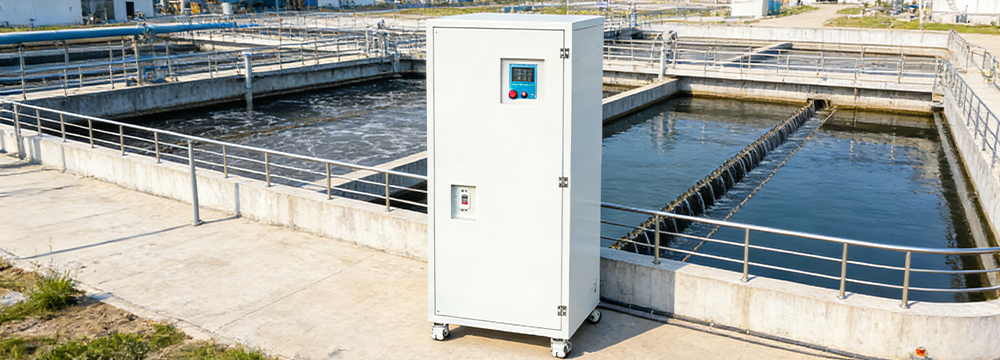
The improvement of water treatment by adjustable power supplies is not only reflected in treatment efficiency, but also brings added value in energy consumption, operation and maintenance, and other aspects, further amplifying their application advantages. In terms of energy consumption, adjustable power supplies can achieve a conversion efficiency of over 94% and a power factor ≥0.98. Compared to traditional thyristor power supplies, efficiency can be improved by more than 30% at load rates below 70%, resulting in annual energy savings of 30,000~50,000 kWh per unit, significantly reducing water treatment operating costs.
In terms of operation and maintenance, adjustable power supplies are equipped with comprehensive protection functions including overcurrent, overvoltage and overheating protection. They support fault self-diagnosis and remote monitoring, which effectively reduces equipment downtime and lowers manual maintenance costs. Meanwhile, these power supplies are 40%–50% more compact than conventional models, saving installation space and meeting the compact layout needs of water treatment facilities, further enhancing the overall efficiency of operation and maintenance.
IV. Conclusion: Adjustable Power Supplies are Key Equipment for Improving Water Treatment Efficiency
In summary, adjustable power supplies, by precisely adapting to the dynamic requirements of water treatment processes, have achieved a quantitative improvement in treatment efficiency of 10% to 40% for different processes. Simultaneously, they have achieved multiple breakthroughs in energy saving, operation and maintenance, and the stability of treatment effects, becoming core equipment driving the high-efficiency and energy-saving development of the water treatment industry. With the continuous upgrading of water treatment processes, adjustable power supplies will further integrate intelligent control and adaptive adjustment technologies, optimize parameter control accuracy, expand application scenarios, and provide stronger support for water resource recycling and environmental governance, helping to achieve the water treatment goals of "high-efficiency treatment, energy saving and consumption reduction, and green environmental protection."