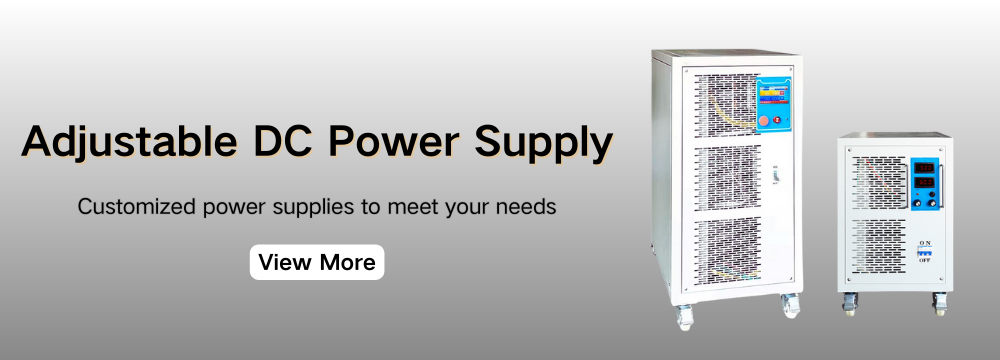
In industrial control, new energy storage, communication base stations, precision electronic equipment, and other fields, DC power supply systems have become the core power supply carrier due to their advantages of stable power supply, low loss, and strong adaptability. Adjustable power supplies, as the "energy conversion hub" of DC power supply systems, bear the critical responsibility of converting AC grid power into stable DC power and flexibly adjusting output parameters according to load requirements. Their operating efficiency directly determines the energy consumption level of the entire DC power supply system. Statistics show that the energy loss of ordinary adjustable power supplies accounts for approximately 8% to 15% of the total energy consumption of the DC power supply system. Achieving high-efficiency and energy-saving operation of adjustable power supplies can not only significantly reduce the electricity costs of enterprises but also minimize energy waste, which is in line with the development trend of green and low-carbon industries. Therefore, exploring efficient and energy-saving implementation paths for adjustable power supplies in DC power supply systems has become an important topic in industrial energy conservation and power supply design.
1. Optimizing Topology and Components: The Foundation for High Efficiency
Optimizing the topology design is the core foundation for achieving high-efficiency and energy-saving operation of adjustable power supplies. The core logic is to reduce inherent losses during the power conversion process. Traditional adjustable power supplies mostly use hard-switching topology structures, where switching devices generate significant switching losses during conduction and cutoff, and the conduction loss and reverse recovery loss increase significantly at high frequencies, resulting in low overall power supply efficiency. To solve this problem, soft-switching topology structures should be used to replace traditional hard-switching designs. Currently, the most widely used are LLC resonant topology and phase-shifted full-bridge topology. The LLC resonant topology achieves zero-voltage switching (ZVS) and zero-current switching (ZCS) of switching devices through a resonant cavity, which can significantly reduce switching losses, especially in high-frequency operation scenarios, where the efficiency improvement is more significant. Compared with traditional hard-switching topologies, the efficiency can be increased by 5% to 10%; the phase-shifted full-bridge topology optimizes the power conversion process by adjusting the conduction phase of the switching tubes, reducing conduction loss and ripple loss, and is suitable for the energy-saving needs of medium and high-power DC power supply systems.
Adapting to load characteristics and optimizing operating modes are key factors in achieving energy-saving operation of adjustable power supplies in DC power supply systems. The load of DC power supply systems often exhibits dynamic characteristics, such as the load of communication base stations fluctuating with communication traffic and the load of industrial equipment changing with operating conditions. If the adjustable power supply remains in a fixed operating mode, maintaining rated power output regardless of the load size, it will lead to a significant decrease in efficiency under light load and no-load conditions, resulting in energy waste. To address this problem, the adjustable power supply needs to have a multi-mode adaptive switching function to achieve "load-matching energy saving." Under full load and heavy load conditions, a high-frequency operating mode is used to ensure that the power conversion efficiency remains above 90%; under light load and no-load conditions, it automatically switches to a low-frequency sleep mode or intermittent working mode to reduce the switching frequency and no-load losses. For example, when the load rate is below 20%, switching to low-frequency operation can reduce no-load losses by 30% to 50%. At the same time, the switching logic of the constant voltage, constant current, and constant power operating modes needs to be optimized to reduce energy loss during mode switching and ensure efficient operation under different load scenarios.
Selecting high-efficiency and energy-saving hardware components and optimizing component parameter matching are important guarantees for reducing the inherent losses of adjustable power supplies. The energy loss of adjustable power supplies mainly comes from core components such as switching devices, filtering components, and transformers. Therefore, component selection should be based on the core principle of "low loss and high efficiency." Switching devices should prioritize wide-bandgap semiconductor devices such as gallium nitride (GaN) and silicon carbide (SiC). Compared with traditional silicon-based MOS transistors, GaN and SiC devices have the advantages of low on-resistance, fast switching speed, and low reverse recovery loss, which can reduce switching losses by more than 60%, while improving the power density and efficiency of the power supply; transformers should use high-frequency, low-loss cores and optimize the winding structure to reduce core loss and copper loss. For example, using nanocrystalline cores instead of traditional silicon steel sheet cores can reduce core loss by 20% to 30%; filtering components should use capacitors and inductors with low equivalent series resistance (ESR) to reduce energy loss during the filtering process and improve the stability of the output voltage, indirectly reducing additional energy consumption caused by excessive ripple.
2. Intelligent Control and Adaptive Operation: The Key to Dynamic Energy Saving
Introducing intelligent control and precise adjustment technologies to achieve full-process energy saving optimization is an important complement to improving the energy efficiency of adjustable power supplies. The operating conditions of DC power supply systems are complex and variable, and achieving ultimate energy efficiency is difficult with hardware optimization alone; it requires combining intelligent control technology to adapt to changing operating conditions in real time. On the one hand, integrating high-precision sampling and feedback adjustment modules allows for real-time collection of input voltage, output voltage, current, and load change data. Through an adaptive PID control algorithm, the switching frequency and output parameters are precisely adjusted to ensure the power supply always operates in the optimal efficiency range, avoiding energy loss caused by parameter deviations. It also enables seamless integration with the monitoring platform of DC power supply systems, supporting remote monitoring, parameter configuration and energy consumption metering. Operators can keep real-time track of the power supply’s operational status and energy consumption data, and make timely optimizations and adjustments in case of high energy consumption. Additionally, an energy-saving sleep mode is built in: when the DC power supply system is on standby or under no-load conditions for an extended period, the adjustable power supply will automatically switch to sleep mode, with only the core circuits running at low power. This effectively cuts down on standby energy consumption to a significant extent.
3. Thermal Management and Maintenance: Ensuring Sustained Performance
Optimizing the heat dissipation structure design and strengthening daily operation and maintenance are crucial for ensuring the long-term efficient and energy-saving operation of adjustable power supplies. This effectively prevents efficiency degradation and increased energy consumption caused by overheating or component aging. In terms of heat dissipation design, it is necessary to combine high-efficiency cooling fans with large-area heat sinks, taking into account the power specifications and operating conditions of the adjustable power supply. This should be coupled with an intelligent temperature control system that monitors the temperature of internal components in real time and automatically adjusts the fan speed—reducing speed at lower temperatures and increasing speed when temperatures exceed limits—thus fundamentally avoiding inefficient energy consumption caused by prolonged high-speed fan operation. For high-power adjustable power supplies, liquid cooling can be used instead of traditional air cooling, significantly improving heat dissipation efficiency, stabilizing component operating temperatures, and reducing energy consumption and noise from fan operation, further optimizing energy saving effects. In terms of daily operation and maintenance, a regular maintenance mechanism should be established to periodically clean dust and debris from the heat dissipation channels to ensure smooth airflow. Simultaneously, the aging and wear of core components should be checked, and components with excessive wear or performance degradation should be replaced promptly to ensure that the adjustable power supply remains in optimal operating condition, preventing problems such as increased conduction losses and decreased conversion efficiency caused by component aging, and continuously maintaining energy-saving operation levels.
In summary, achieving high-efficiency and energy-saving operation of adjustable power supplies in DC power supply systems is a systematic project involving "topology optimization + mode adaptation + hardware upgrade + intelligent control + operation and maintenance guarantee." The core is to achieve comprehensive improvement of power supply operating efficiency by optimizing the power conversion process, adapting to dynamic load changes, and reducing inherent losses. With the continuous development of wide-bandgap semiconductor technology and intelligent control technology, the energy-saving potential of adjustable power supplies will be further unleashed. In the future, they will develop towards higher efficiency, lower losses, intelligence, and miniaturization, providing strong support for the green and energy-efficient operation of DC power supply systems. This will help industrial enterprises achieve the dual goals of reduced energy consumption and increased efficiency, and promote the high-quality development of green and low-carbon industries.