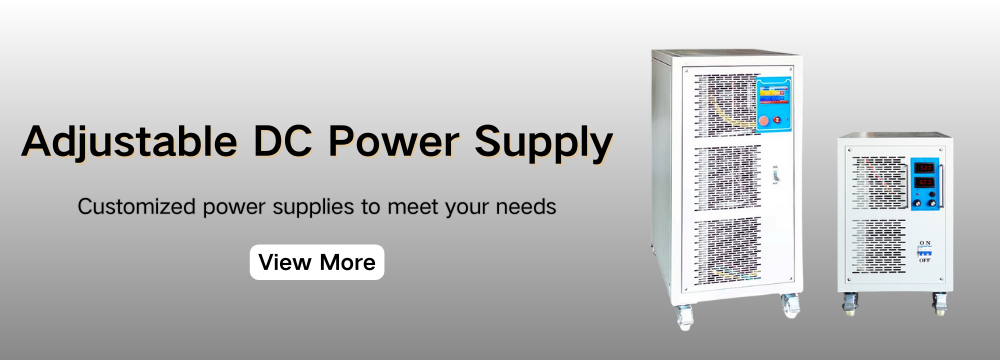
The entire water treatment process includes several key stages: pretreatment, core treatment, advanced treatment, and water reuse. Each stage has totally different processes, which means their requirements for voltage, current, and power are also vastly different. As the "intelligent power hub" of a water treatment system, adjustable power supplies use their flexible control and precise adaptation abilities to get around the limitations of fixed power supplies. They match the power needs of each stage perfectly, making sure the whole system runs stably and efficiently. So, how exactly do these adjustable power supplies adapt to the power demands of the entire water treatment process?
Pretreatment Stage: Adapting to Demanding Conditions, Maintaining Stable Power Supply
In the preprocessing stage, adjustable power supplies can adapt well to harsh working conditions, balancing stability and protection. Preprocessing mainly involves screening, coagulation, and precipitation - processes such as electrocoagulation and electroflotation also belong to this stage, which require real-time adjustment of power parameters. When the quality of raw water fluctuates sharply (such as sudden surge in sewage concentration during heavy rain or unexpected changes in impurities in industrial wastewater), the adjustable power supply can quickly adjust the current density. If the pollutant concentration in the raw water is high, they’ll boost the current a bit to promote flocculant formation and improve impurity separation; when the water quality is good, they’ll lower the output power to avoid wasting energy. Plus, the pretreatment environment is tough—damp and full of impurities—so adjustable power supplies come with anti-interference and anti-corrosion designs to keep the power supply running without interruption.
Core Treatment Stage: Precise Control, Meeting Stringent Process Requirements
In the core treatment stage, adjustable power supplies offer precise control that matches the core needs of the process. Core treatment is key to making sure water meets quality standards—it includes processes like electrochemical oxidation, membrane separation, and biological treatment, all of which need extremely high power supply accuracy. For example, when using electrochemical oxidation to treat high-concentration organic wastewater, you need to continuously fine-tune the voltage based on how much the pollutants have degraded. This controls the oxidation reaction rate and prevents excessive electrolysis from causing energy consumption to skyrocket. For EDI ultrapure water production, adjustable power supplies can smoothly switch between constant voltage and constant current modes to fit the ion migration needs of the membrane module. This not only ensures the purity of the treated water but also prevents damage to the membrane module from abnormal voltage, keeping output accuracy within ±1% and meeting the strict demands of the core process.
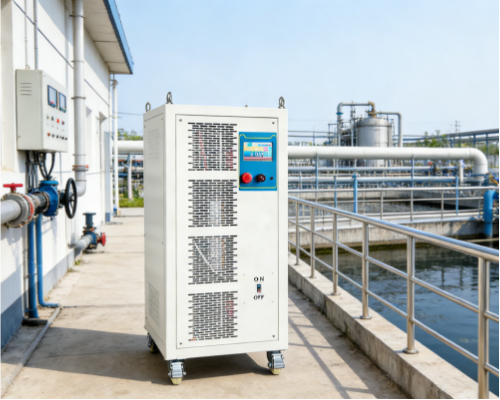
Advanced Treatment and Reuse: Dynamic Adaptation, Balancing Energy Efficiency and Effectiveness
In the advanced treatment and reuse stage, adjustable power supplies dynamically adapt to balance energy efficiency and effectiveness. Advanced treatment primarily involves disinfection, desalination, and decolorization. Different reuse scenarios (such as industrial reuse and municipal non-potable use) have different water quality requirements, and thus varying power demands. Adjustable power supplies can precisely match the power parameters of disinfection equipment and reverse osmosis devices according to reuse standards.When we talk about the high-pressure pump in a reverse osmosis system we need to think about the voltage. The voltage is important because it helps to keep the water pressure stable. This is a thing because it stops the membrane from getting all clogged up.
The UV lamp power supply is used to make the water clean. We can change how power it uses based on how cloudy the water is. If the water is really cloudy the UV lamp power supply will use power to make sure it gets clean. If the water is not that cloudy it will use power. This is good because it helps to save energy. The reverse osmosis system and the UV lamp power supply are important, for making the water clean and safe to use. What’s more, given that reuse systems often operate intermittently, adjustable power supplies are capable of fast startup and shutdown, dynamic load adjustment, and can adapt to load fluctuations, which in turn reduces standby energy consumption.
Full-Process Linkage: Enabling Intelligence and Adapting to Diverse Scenarios
In addition to adapting to each stage, adjustable power supplies can also achieve full-process linkage adaptation, facilitating intelligent system operation. Modern water treatment systems often employ intelligent control systems. Adjustable power supplies are equipped with digital interfaces, allowing them to link with the central control system, receiving real-time water quality and load data from each stage, and automatically adjusting power supply parameters without manual intervention. At the same time, its wide-range adjustment characteristics can adapt to water treatment projects of different scales and processes. Whether it's a small sewage treatment plant or a large industrial water treatment system, the power and voltage range can be adjusted to meet the power needs of the entire process, avoiding redundant power supply investments.
In summary, adjustable power supplies, through a model of "rough adaptation in pretreatment, precise control in core stages, and dynamic adaptation in advanced reuse," balance stability, precision, and energy efficiency, perfectly matching the differentiated power needs of the entire water treatment process. It is not only a power guarantee for the stable operation of various processes but also a key to achieving energy saving, consumption reduction, and intelligent upgrading of water treatment systems, providing flexible and efficient power supply solutions for water treatment projects of different scenarios and scales.