In industrial production environments, adjustable power supplies act as the core power source for a diverse range of precision devices and automated production lines. Their output accuracy exerts a direct influence on the quality of finished products and the continuity of production processes. It also stands as a vital prerequisite for upholding stable production operations.
Consider the precise testing of electronic components, the steady power supply for PLC devices, or the dependable operation of high-precision instruments. Even a minor deviation in accuracy can trigger equipment malfunctions, off-specification product parameters, or even full production line downtime. Such issues invariably lead to substantial economic losses.
For this reason, mastering standardized calibration methods for adjustable power supply output accuracy is essential. Avoiding various potential issues during the calibration process is equally important. Together, these steps form an indispensable component of regular industrial production workflows.
So, how can calibration work be conducted in a scientific manner? How do we ensure that output accuracy adheres to set standards and safeguards uninterrupted production stability?
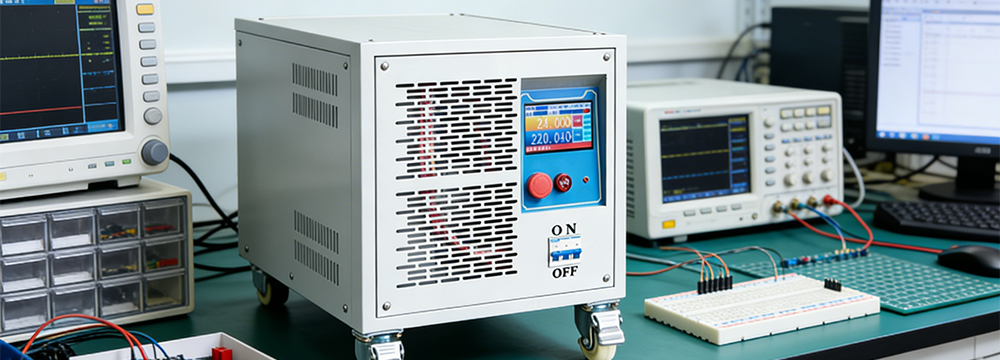
Thorough preparatory work is the prerequisite for effective calibration. It serves as the foundation for preventing calibration errors and securing accurate test results. Yet, this critical step is frequently overlooked by many industry practitioners. First, the calibration standards and environmental requirements must be clearly defined. The calibration of industrial-grade adjustable power supplies must strictly follow national metrology standards to ensure that the calibration results are universal and authoritative, and can be used as a basis for subsequent equipment maintenance and quality traceability; at the same time, the calibration environment needs to be strictly controlled, with a temperature of 15-25℃ and a relative humidity of 45%-75% being ideal, away from strong electromagnetic interference, vibration sources, and dusty areas, to prevent environmental factors from causing calibration instrument malfunctions and distorted measurement data. Secondly, specialized calibration tools must be prepared, including a high-precision multimeter with an accuracy level 1-2 levels higher than the adjustable power supply, a standard load matching the actual production requirements, loss-free calibration connecting wires, and the equipment's original manufacturer's operation manual, ensuring that every calibration step is standardized and supported by the necessary tools.
The core of standardized step-by-step operation is to proceed systematically according to the process to maximize calibration accuracy and meet the actual needs of industrial production. The first step is equipment preheating and zeroing. Connect the adjustable power supply, high-precision multimeter, and standard load to the power supply simultaneously, and preheat for at least 30 minutes to allow all equipment to reach a stable working state, avoiding measurement errors in a cold state; then, set the multimeter to the corresponding voltage and current ranges and perform a zeroing operation to eliminate the instrument's inherent deviations. The second step is no-load voltage accuracy calibration.Disconnect the standard load, and tune the adjustable power supply to a host of common voltage grades in industrial manufacturing – 5 volts, 12 volts and 24 volts, for instance. When the output becomes steady use a multimeter to check the voltage at the power supplys output terminal. Compare this voltage reading to the value shown on the power supplys control panel. If the difference is too big make changes to the voltage output settings using the calibration keys, on the panel or the special software. Keep making these changes until the voltage reading matches the voltage of the power supply. Check the power supplys voltage again to make sure it is correct.
Now we get to the load calibration part. This is an important step because it is similar to what happens in real life industrial situations. You see, in factories and such the power supplies are always working with a load on them. So even if the power supply works perfectly when it is not under load that does not mean it will keep working when it has a load on it. To do the load calibration you need to connect a load that is like the one you will be using in your actual work. Then you set the power supply to the voltage. Current it is supposed to be and measure the actual voltage and current. After that you compare these values to what the power supply says they are. Load calibration is like a test to see how well the power supply works when it is, under load. It is a crucial step to make sure the power supply works correctly in real industrial operating conditions like the ones you will be using it in with your actual production load. We need to adjust the parameters that're way off one at a time and then we do the test again two or three times to make sure the precision is good when it is under load. The next thing to do is -point calibration and write it all down. To get the range of output we have to do multi-point calibration at low voltage, medium voltage and high voltage so we do not have the same problems as single-point calibration. Multi-point calibration is important because it helps us cover the output range of the equipment and multi-point calibration is better, than single-point calibration. We have to do -point calibration at these different voltage grades to get accurate results. Simultaneously, record detailed calibration data, calibration time and environmental parameters to compile a comprehensive calibration report, which facilitates subsequent traceability, maintenance and rechecks.
Equally critical to sustaining long-term precision stability are the precautions during calibration and the subsequent maintenance routines. During the calibration process, refrain from frequent switching of power supply grades and frequent load plugging and unplugging, lest abrupt voltage and current fluctuations damage the equipment or skew measurement results. Ensure the connecting wires are firmly fastened to avert errors arising from poor contact. Calibration personnel must be proficient in equipment operation, and arbitrary modification of calibration parameters is strictly forbidden to prevent equipment malfunctions caused by improper operation. For subsequent maintenance, it is recommended that rechecks and calibrations be carried out every three to six months in general industrial settings; for high-load and severe operating environments, however, the interval should be shortened to one to three months. Regularly clean the power supply’s heat dissipation vents, inspect the aging status of connecting wires, and replace damaged components promptly. By doing so, the adjustable power supply can be maintained in an optimal working state for an extended period, thereby eliminating the risks of precision deviation from the root cause.
In summary, adjustable power supply output accuracy calibration is a rigorous and meticulous systematic process. From preliminary preparation and standardized operation to subsequent maintenance, every link must be taken seriously. Only by strictly following scientific procedures and controlling every detail can we ensure the stable output accuracy of adjustable power supplies, providing reliable power support for industrial production, reducing production failures and economic losses caused by accuracy deviations, and guaranteeing the continuous, efficient, and stable operation of production lines.