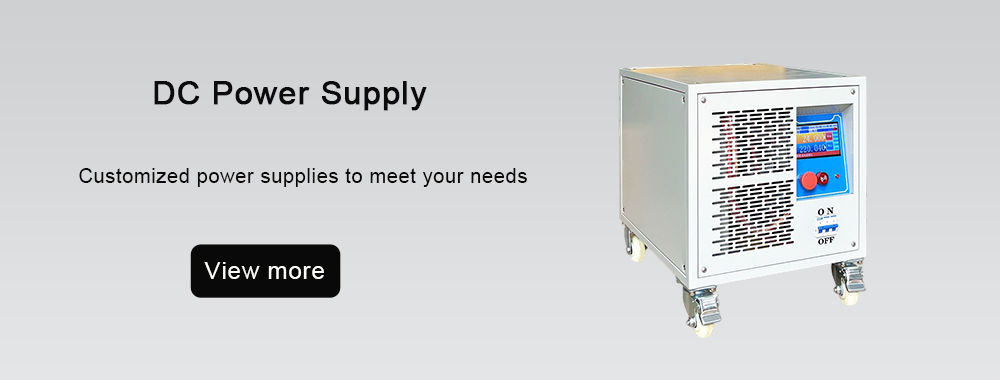
The pulse power supply is available in single positive pulse and dual positive/negative pulse versions, employing unique modulation technology and digital control. The positive pulse on-time width (T+) and negative pulse on-time width (T-) can be adjusted independently throughout the entire cycle. Positive current and voltage regulation, as well as negative current and voltage, are all independently adjustable, fully meeting diverse customer needs.
The pulse power supply is suitable for gold, silver, nickel, and tin plating, significantly improving plating performance. When used for protective-decorative electroplating (such as decorative gold), it produces a uniform color, high brightness, and strong corrosion resistance. In particular, the anodic dissolution of the reverse pulse in the dual-pulse power supply rapidly increases the metal ion concentration on the cathode surface, facilitating the use of high pulse current densities in subsequent cathode cycles, resulting in a dense, bright plating with low porosity. The anodic stripping of the reverse pulse in the dual-pulse power supply significantly reduces the adhesion of organic impurities (including brighteners) in the plating, resulting in high plating purity and strong resistance to discoloration. Dual-pulse power supplies are a new type of power supply. Due to the rational processing of high-frequency and low-frequency pulses, their application areas have become wider.
Basic Working Principle of Pulse Power Supply Technology
First, the primary energy source undergoes slow energy storage to ensure sufficient energy. Then, it charges (or receives) the intermediate energy storage and pulse shaping system. After complex processes such as storage, compression, pulse formation, or conversion, the energy is finally rapidly discharged to the load.
Pulse Power Supply Selection
The selection of a pulse power supply depends on the requirements of the electroplating process: For ordinary electroplating processes, rectifiers with a capacity less than 3kW can use a single-phase input power supply; however, for capacities greater than 3kW, a three-phase input power supply should be selected to prevent grid voltage imbalance. For special electroplating processes with high ripple coefficient requirements (such as hard chrome plating), waveform continuity is particularly important. In such cases, a silicon rectifier with voltage regulation or a thyristor rectifier with added filters can be selected.
Special electroplating processes also have specific requirements for the output waveform, such as single-phase commutation, periodic commutation, unidirectional pulses, bidirectional pulses, DC-DC superimposed pulses, DC-AC superimposed pulses, and multi-segment mixed waveforms. Different output waveforms correspond to different applications. Power supply manufacturers specify different models for different output waveforms and applications, so the type of power supply can be selected according to the required output waveform.
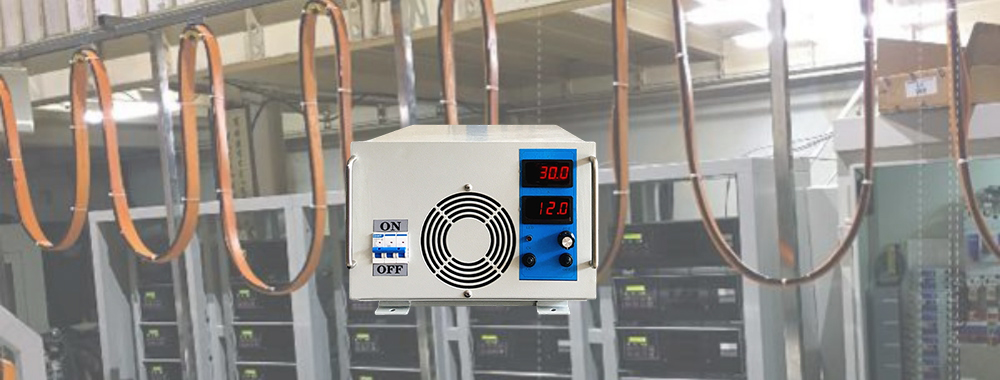
Applications of Pulse Power Supplies
When used for electroplating gold, silver, nickel, tin, and alloys, pulse power supplies can significantly improve the functionality of the plating layer; when used for protective-decorative electroplating (such as decorative gold), they can produce a uniform color, good brightness, and strong corrosion resistance.
When used for precious metal purification, pulse power supplies result in higher purity of the precious metals. Pulse power supplies are superior to traditional electroplating power supplies and represent the future direction of electroplating power supply development.
Dual-pulse power supplies produce finer plating and better finish than single-pulse power supplies. The anodic dissolution of the reverse pulse in a dual-pulse power supply causes a rapid recovery of the metal ion concentration on the cathode surface, which is beneficial for using a high pulse current density in subsequent cathode cycles, resulting in a dense, bright plating layer with low porosity; the anodic stripping of the reverse pulse in a dual-pulse power supply greatly reduces the adhesion of organic impurities (including brighteners) in the plating layer, resulting in high purity and strong resistance to discoloration.
Dual-pulse power supplies are suitable for electroplating of gold, silver, rare metals, nickel, zinc, tin, chromium and alloys; electroforming of copper, nickel and other metals; energizing of electrolytic capacitors; anodizing of aluminum, titanium and other products; electrolytic polishing of precision parts; and charging of storage batteries.
YIBENYUAN Power Expert:
We specialize in custom DC power supplies to meet your specific requirements.
Our product range spans from 0V to 2000KV DC and from 0A to 20000A, with customized input and output voltages and currents.
Thank you for considering our services.