In the modern industrial production system, high-power electric heating equipment has been widely used in many key scenarios such as material smelting, heat treatment, drying, chemical reaction, and pipeline tracing. With the increasing requirements of equipment for temperature control accuracy, operation efficiency, energy consumption and long-term reliability, traditional power supply and voltage regulation methods have gradually exposed shortcomings such as slow response, low accuracy, large loss and obvious impact on the power grid. Three core technologies, namely full-bridge/half-bridge topologies, three-phase rectification plus chopper voltage regulation, and resonant conversion, have become mainstream technical solutions for high-power power supplies in the field of electric heating due to their respective advantages in circuit structure, control mode and energy conversion. Proper selection and combination of these technologies can significantly improve the overall performance of heating systems and provide stable, efficient and energy-saving power support for industrial heating equipment.
Applications of Full-Bridge and Half-Bridge Topologies in High-Power Electric Heating
Full-bridge and half-bridge topologies are inverter architectures based on power switching devices such as IGBTs, and are also one of the most commonly used circuit forms in current high-power power supplies. The half-bridge topology is composed of two sets of power switches, resonant capacitors and inductors. It has a relatively simple structure, mature control logic and lower device cost, making it suitable for medium-power electric heating scenarios. In injection molding machine heating units, small air duct heaters, mold preheating, conventional ovens and other equipment, the half-bridge topology can output power smoothly, achieve smooth start-up and continuous adjustment, and reduce the impact on the power grid at the moment of startup. In high-power power supply applications of tens of kilowatts, the half-bridge solution can effectively control the overall cost on the premise of ensuring stability, and has good engineering practicability. However, limited by voltage utilization, when the half-bridge topology is expanded to higher power, the loop current will increase significantly, leading to increased device temperature rise and loss, so it is more suitable for medium-power, cost-sensitive heating scenarios.
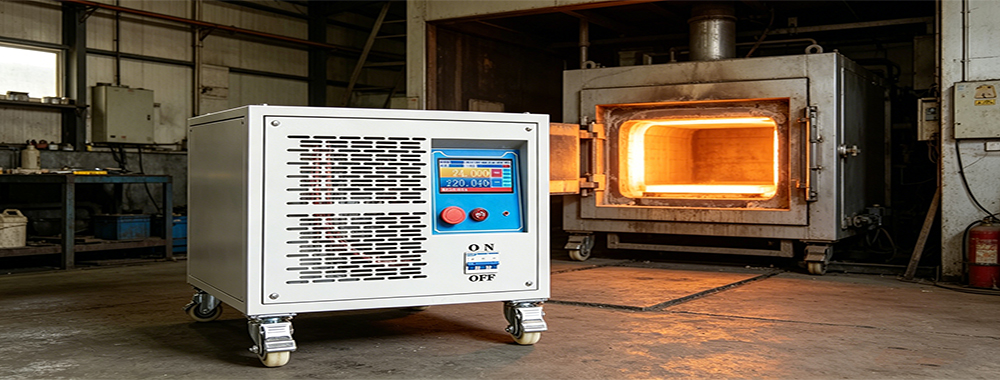
The full-bridge topology uses four sets of power switches to form an H-bridge structure with higher voltage utilization and lower current stress, making it an ideal choice for high-power and ultra-high-power electric heating systems. In industrial resistance furnaces, induction heating equipment, multi-zone synchronous temperature control ovens, high-power heating tube arrays and other scenarios, the full-bridge topology can realize constant voltage, constant current and constant power output with closed-loop control, effectively avoiding power fluctuations caused by the change of heating element resistance with temperature. At the same time, the full-bridge architecture can be more easily combined with soft-switching technology to greatly reduce switching losses, improve the efficiency of the whole machine, and meet the needs of long-term full-load operation. Its excellent scalability supports multi-module parallel connection and partition independent temperature control, which can adapt to the centralized control and automatic regulation of large production lines, making it the core technical direction of high-end high-power power supplies.
Applications of Three-Phase Rectification + Chopper Voltage Regulation in High-Power Electric Heating
Three-phase rectification combined with chopper voltage regulation is a mature and stable power regulation scheme, which is widely used in industrial high-power electric heating systems. This technology first converts alternating current into smooth direct current through a three-phase rectifier circuit, and then uses a DC/DC chopper circuit to continuously and accurately adjust the output voltage and power. It has the characteristics of fast response, high temperature control accuracy and stable output characteristics. Compared with traditional voltage regulation methods, this solution can effectively suppress grid harmonics, improve power factor, reduce power waste, and better comply with modern industrial power consumption specifications.
In high-power pipeline tracing, heat treatment furnaces, chemical reactor heating, electroplating tank heating and other scenarios, the three-phase rectification plus chopper voltage regulation scheme shows excellent adaptability. It can adapt to resistive loads and some inductive loads, and has complete current limiting, voltage limiting, overload and over-temperature protection mechanisms to ensure that high-power power supplies remain reliable and stable during long-term continuous operation. For equipment that requires uniform heating, small temperature fluctuations and smooth power adjustment, this solution can effectively improve product processing consistency and reduce failure rates, making it a preferred solution that balances stability and economy in medium and high-power electric heating systems.
Applications of Resonant Topologies in High-Power Electric Heating
Resonant conversion technology relies on a resonant network to make power devices work in a soft-switching state, greatly reducing switching losses and electromagnetic interference, making it an important technical route for high-efficiency high-power power supplies. In high-frequency heating, induction heating, precision temperature control and other scenarios, resonant topologies have outstanding advantages, maintaining high conversion efficiency at high operating frequencies while reducing interference to surrounding electrical equipment.
Resonant high-power power supplies are often used in fields requiring high heating speed and temperature uniformity, such as metal smelting, high-frequency heat treatment, semiconductor high-temperature baking, and new material sintering. It can achieve rapid heating and precise temperature control, reduce the thermal shock to heating elements, and extend service life. In continuous and automated production lines, resonant electric heating systems can stably match production beats, improve production efficiency and reduce unit product energy consumption, promoting the upgrading of electric heating equipment towards high efficiency, low consumption and intelligence.
Summary of Technical Selection and Engineering Practice
In actual engineering design, the three technical routes have their own applicable scenarios: half-bridge topology is suitable for medium-power, cost-sensitive conventional heating equipment; full-bridge topology faces high-power, high-reliability, high-precision temperature control systems; three-phase rectification plus chopper voltage regulation balances stability and control accuracy, suitable for scenarios with high requirements for power grid quality; resonant type mainly features high efficiency, high frequency and low interference, suitable for high-end precision heating requirements. Designers need to make a comprehensive selection based on power level, load characteristics, temperature control requirements, operating environment and budget.
Adopting appropriate circuit topology and regulation scheme can not only improve heating efficiency and reduce energy consumption, but also reduce downtime and extend the overall service life of equipment. In actual project implementation, YIBENYUAN can provide high-power power supply products and customized solutions based on the above technical routes according to different electric heating working conditions, helping industrial heating equipment achieve more stable, efficient and energy-saving operation.
With the continuous development of industrial heating towards high power, refinement and intelligence, these three types of technologies will continue to be optimized and upgraded, providing stronger technical support for the application of high-power power supplies in the field of electric heating, and promoting the high-quality development of the entire industry.