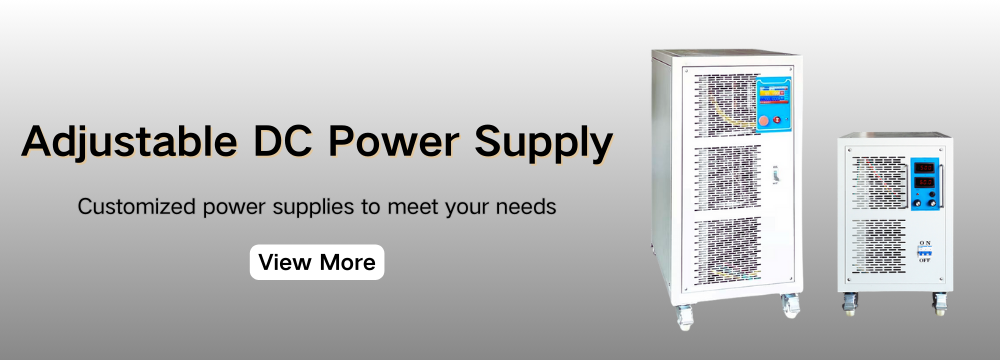
During the practical conduct of electrolysis experiments, a common misconception plagues many operators: assumed by them is that any standard DC power supply suffices to complete the experiment, while overlooked is the decisive impact of power supply stability on experimental outcomes. When ordinary DC power supplies are employed for electrolysis, students frequently encounter a host of issues: rapidly blackened or passivated electrodes, unpredictably fluctuating and unmanageable reaction rates, and chaotic recorded experimental data. Even after repeated attempts, elusive remain the desired results.
In reality, rooted not in improper electrode selection or electrolyte preparation errors, but in power supply equipment failing to meet the experiment’s specific requirements, are the root causes of these problems. At the core of an electrolysis experiment lies a controllable electrochemical reaction; unable to provide the stable electrical energy required to sustain this process are ordinary DC power supplies, whereas precisely the key to resolving these issues and ensuring smooth experimental progression is a constant voltage and constant current power supply.
A question often arises among many: since both are DC power supplies, why is the specific selection of a constant voltage and constant current model absolutely necessary for electrolysis experiments? Simple indeed is the answer: inextricably linked to current and voltage is every stage of an electrolysis reaction. Determined by current density is the reaction rate; dependent on voltage is the reaction’s feasibility; and even influenced by voltage and current fluctuations are the type and purity of reaction products. Even minute fluctuations in voltage or current can cause the reaction to deviate from its intended path, distort experimental data, and ultimately render the entire experiment futile.
Embedded in the core value of a constant voltage and constant current power supply is its ability to provide stable, controllable electrical energy for electrolysis experiments—thereby mitigating various experimental risks and guaranteeing result integrity. This is the fundamental reason why it has become an irreplaceable piece of equipment for electrolysis research. Drawing upon practical experience in daily laboratory operations, in greater detail shall we examine why this type of power supply is truly irreplaceable.
I. Stable Power Supply: Laying the Foundation for Experimental Controllability and Reproducibility
“Controllable reactions” and “reproducible data” are the primary requirements for an electrolysis experiment. A prerequisite for achieving these goals is the maintenance of constant current and voltage. Directly proportional to current density is the rate of an electrolysis reaction, while determining whether the reaction can proceed successfully is the voltage. Consequently, fluctuate the current or voltage, and oscillate will the reaction intensity—strengthening and weakening erratically—and may even cause the reaction to shift in an unintended direction.
Lacking built-in regulation capabilities for constant voltage and constant current operation are ordinary DC power supplies; as a result, significant drift in their output voltage and current can occur in response to grid fluctuations or changes in electrolyte solution impedance. For instance, during water electrolysis experiments, fluctuating voltage leads to unstable hydrogen and oxygen production rates, resulting in significant deviations in the volume ratio of collected gases. Similarly, in electroplating experiments, current fluctuations cause uneven plating thickness, surface dullness, and peeling, making a uniform coating unattainable.
Precisely lockable onto a set voltage or current value is a constant-voltage/constant-current power supply. Regardless of grid fluctuations, changes in electrolyte concentration, or impedance shifts caused by electrode reactions, stable output is maintained, ensuring that the electrolysis reaction proceeds consistently under preset conditions. Consequently, reproducible become experimental results and verifiable becomes data, preventing experimental failures caused by unstable power supply—making this technology particularly suitable for high-precision environments such as scientific research and student group experiments.
II. Protecting Electrodes and Electrolytes: Mitigating Experimental Safety Hazards
In electrolysis experiments, critical consumables are electrodes, while acidic or alkaline solutions typically constitute electrolytes; a primary cause of electrode damage and significant safety risks is improper power supply. Lacking overcurrent and overvoltage protection are standard DC power supplies; upon startup, a substantial current surge is generated, which can easily puncture electrodes, burn their surfaces, or even lead to electrode detachment and short circuits.
Effectively addressed by constant-voltage/constant-current power supplies is this critical issue, through the incorporation of built-in soft-start, overcurrent, overvoltage, and short-circuit protection features. A gradual ramp-up of voltage and current is enabled by the soft-start function, thereby preventing sudden surges that could damage electrodes. Furthermore, occur a short circuit or excessive current during an experiment, and automatically cut off will the power supply’s output, with an alarm triggered simultaneously—a mechanism that not only protects electrodes and extends their lifespan but also prevents safety hazards such as electrolyte splashing and equipment overheating.
For example, during the electrolytic refining of copper, excessive current from a standard power supply can cause the copper anode to dissolve too rapidly, resulting in a rough and uneven copper deposit on the cathode, or even electrode burnout. In contrast, precise current control is allowed by a constant-voltage/constant-current power supply, ensuring both refining efficiency and electrode protection, thereby enabling the experiment to proceed safely and in an orderly manner.
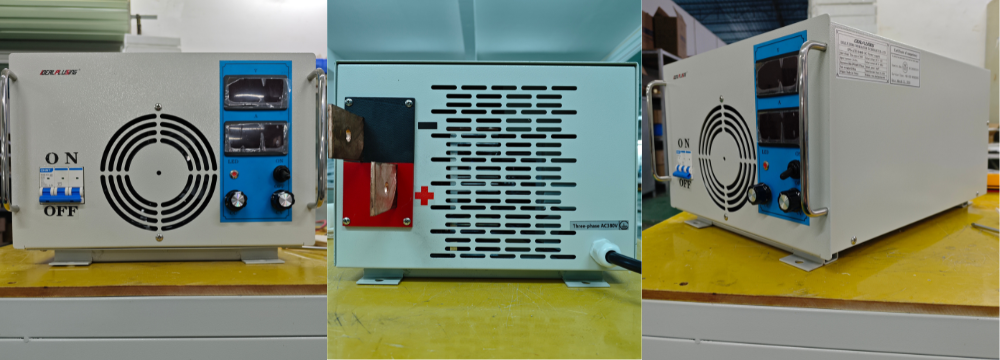
III. Precise Parameter Control: Adapting to Diverse Experimental Requirements
Vastly different requirements regarding voltage and current parameters are imposed by different electrolysis experiments. For instance, relatively low voltage (6–12 V) and moderate current are required for water electrolysis experiments, whereas significantly higher voltage (exceeding 20 V) is demanded by the electrolysis of molten salts. Nothing more than a stable power supply is typically required for qualitative experiments; however, precise regulation of current and voltage is necessitated by quantitative experiments to calculate reaction rates and product yields.
Fixed outputs or rudimentary fine-tuning capabilities are often featured in standard DC power supplies; ill-suited to the diverse requirements of various experiments are their limited adjustment ranges and low precision. Conversely, continuous adjustment of both voltage and current with high precision (typically reaching ±0.1 V and ±0.01 A) is supported by regulated voltage and current power supplies. This allows users to precisely configure parameters according to experimental needs—even enabling seamless switching between constant-voltage and constant-current modes.
For example, in scientific research, when investigating the impact of varying current densities on electrolysis products, precise adjustment of current is enabled by a regulated power supply to isolate a single variable and yield accurate experimental data. In educational settings, progressively adjust voltage and current can students in accordance with experimental protocols, observing the corresponding changes in reaction phenomena to deepen their understanding of the fundamental principles of electrolysis.
IV. Preventing Data Distortion and Ensuring Experimental Rigor
Whether in student laboratories, scientific research facilities, or industrial electrolysis operations, data integrity remains a core requirement. Directly leading to data distortion and compromising the accuracy of experimental conclusions can be fluctuations in current and voltage. For instance, when calculating the Faraday efficiency of an electrolysis reaction, errors can be introduced into the electrical charge calculation by an unstable current, subsequently skewing the efficiency value and potentially leading to erroneous experimental conclusions.
Consistently maintained by regulated voltage and current power supplies are stable voltage and current levels, ensuring that the total electrical charge passing through the electrolyte is both precise and controllable, thereby rendering experimental data reliable and authentic. Furthermore, data logging capabilities are featured in many such power supplies, allowing for the real-time recording of voltage and current fluctuations throughout the experiment. Facilitated by this is post-experiment data analysis and troubleshooting, further enhancing the overall rigor of the experimental process.
For electrolysis experiments, not merely an “option,” but a “necessity,” is the use of a regulated voltage and current power supply. Beyond providing stable electrical energy—thereby ensuring experimental controllability and data precision—it also serves to protect electrodes, mitigate safety hazards, and accommodate the diverse requirements of various experimental protocols. Whether for fundamental student group projects, advanced scientific research, or industrial electrolysis applications, an indispensable piece of core equipment for ensuring the smooth execution and high quality of experimental work is a regulated voltage and current power supply.
Please do not hesitate to contact us.!