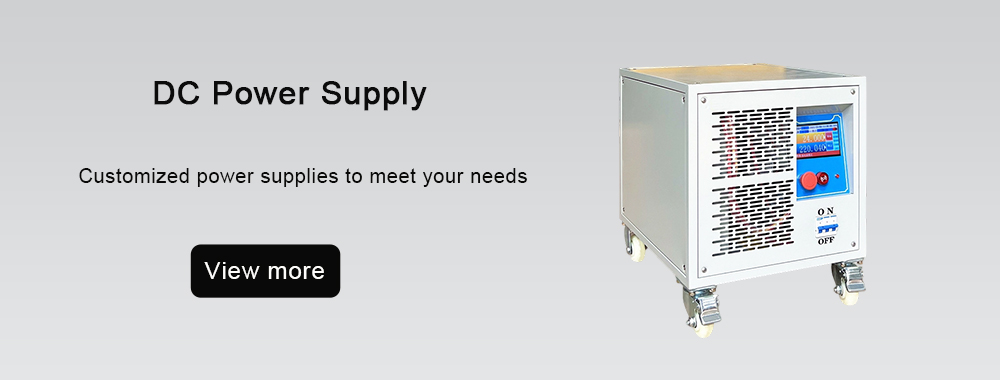
In the field of aluminum alloy surface treatment, the quality of anodizing directly determines the durability and appearance of products. The power supply system plays a key role in the formation of the anodized film. Many people new to anodizing often wonder why ordinary DC power supplies cannot meet production requirements, and why the industry prefers constant current adjustable power supplies. This article explains the necessary connection between anodizing and constant current adjustable power supplies from the perspectives of process principle, production stability and quality control, helping practitioners understand equipment selection logic.
Core Requirement of Anodizing: Stable Current Density
Anodizing is a process of forming a dense oxide film on the surface of aluminum products through electrochemical action. The thickness, hardness and uniformity of the film are directly related to current density. Excessively high current density tends to cause burning, pitting and local overheating, while excessively low current density results in slow film formation, loose structure and poor corrosion resistance. Only a stable and controllable current output can ensure the oxide film grows uniformly as required.
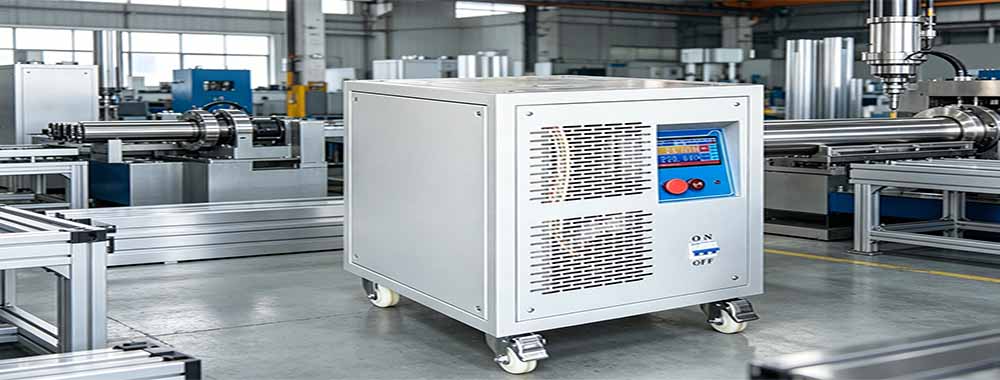
Most ordinary power supplies provide constant voltage output. When the temperature, concentration of electrolyte or workpiece area changes, the current fluctuates accordingly, making it impossible to maintain stable current density. In contrast, a constant current adjustable power supply adopts closed-loop control to automatically adjust the output voltage and keep the set current unchanged, ensuring process consistency from the source.
How Constant Current Adjustable Power Supplies Adapt to the Whole Anodizing Process
The load state changes continuously from startup to film completion in anodizing. Rising electrolyte temperature, changing ion concentration and thickening oxide film all cause fluctuations in bath resistance. The advantage of a constant current adjustable power supply is that it maintains a stable output current regardless of external conditions, avoiding scrapping of entire batches due to parameter drift.
The fine adjustment capability of an adjustable power supply is particularly important in hard anodizing, architectural profile anodizing and precision component anodizing. Operators can fine-tune the current according to material, film thickness and tank size, so that products of different specifications can match the optimal process window. The constant current adjustable power supply also features soft start, avoiding current shock at startup, protecting workpieces and fixtures, and reducing defects.
Constant Current Mode vs. Constant Voltage Mode: Proper Choice for Anodizing
Constant voltage mode suits processes sensitive to potential such as electroplating and electrolytic polishing, but anodizing relies more on stable charge input to control film growth. Under constant voltage, higher temperature increases current, leading to rough film and obvious color difference; lower temperature reduces current, resulting in thin film and insufficient hardness.
With a constant current adjustable power supply, the current remains constant, so the oxide film deposited per unit time is consistent, significantly improving film thickness uniformity, color control and salt spray resistance. For complex workpieces with many edges and corners, a constant current adjustable power supply reduces abnormal tip discharge, making the film on grooves and protrusions more uniform and improving overall yield.
Production Efficiency and Cost Control: Long-Term Value of Adjustable Power Supplies
The stable output of an adjustable power supply shortens process debugging time and reduces rework caused by unstable parameters. High-precision constant current adjustable power supplies feature low ripple and fast response, lowering energy and consumable costs, with obvious savings in electricity and chemicals over long-term use.
In both small-batch trial production and large-scale production lines, the programmable and monitorable features of constant current adjustable power supplies facilitate process data traceability, meeting strict surface treatment requirements in aviation, automotive, electronics and other industries. Brands such as YIBENYUAN, which focus on industrial power supplies, provide better constant current control accuracy, stability and durability to match continuous anodizing production, offering reliable power support for enterprises.
Conclusion
Anodizing is not a simple energizing process, but a precise procedure requiring coordinated control of current, temperature, time and concentration. With stable current output, precise adjustment and strong environmental adaptability, constant current adjustable power supplies have become standard equipment for anodizing. They directly determine film quality, production yield and long-term costs, making them key to enhancing product competitiveness.
Whether for laboratory R&D or factory mass production, choosing a suitable constant current adjustable power supply makes anodizing more stable, quality more controllable and benefits more sustainable.