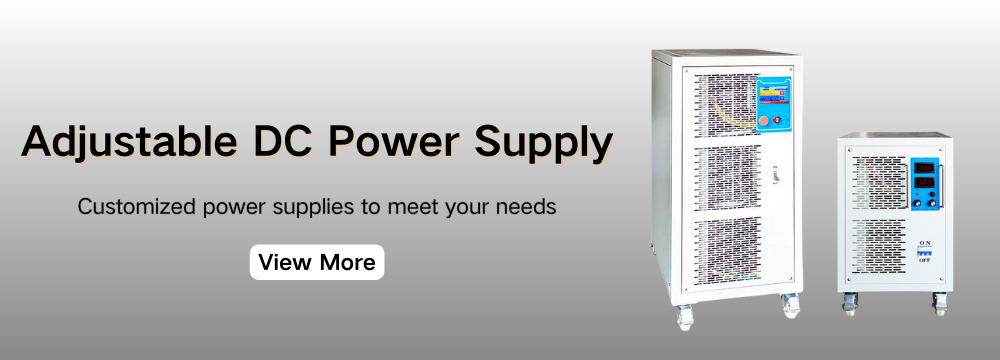
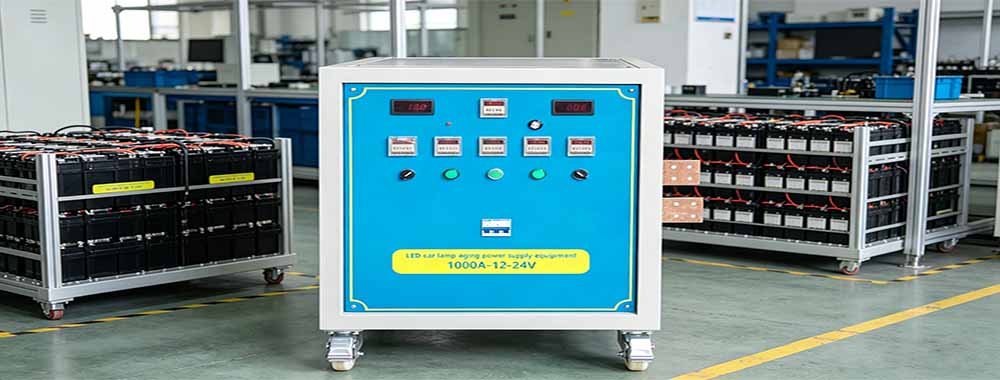
In the quality control procedure before delivery of power supply products, the power supply aging test is a critical process to screen early failures and verify long-term stability. By simulating working conditions such as long-time loading and high-temperature operation, the power supply aging test can centrally expose design defects, material hidden dangers and process flaws, so as to prevent defective products from flowing into the market. Combined with practical engineering experience, this paper analyzes the five types of faults that are most likely to occur in the power supply aging test, providing practical references for production and R&D.
I. Output Voltage Drop: A Typical Manifestation of Insufficient Load Capacity
Output voltage drop is a frequent problem in the power supply aging test. The voltage is basically normal at no-load, but decreases significantly after connecting to the rated load, and even cannot maintain stable output. Such problems are mostly related to the capacity attenuation and increased ESR value of filter capacitors, and may also be caused by the drift of feedback loop parameters or the performance degradation of optocouplers or reference chips. Some products will also experience voltage drop after long-time loading due to insufficient wire diameter of transformer windings or large voltage drop of rectifier tubes. The power supply aging test can quickly identify such weak links to avoid equipment shutdown due to insufficient voltage in actual operation.
II. Overcurrent Protection Triggering: Signals of Abnormal Load and Internal Short Circuit
Overcurrent is a key safety fault that needs urgent attention in the power supply aging test. It is manifested that the protection circuit operates and the output is interrupted shortly after startup or after a period of operation. Common causes include local short circuit on the output side, breakdown of filter capacitors, performance degradation of MOS tubes, and may also be caused by instantaneous high current induced by load configuration exceeding the rated range or poor wire contact. Standardized power supply aging tests are equipped with graded protection, which not only prevents damage to prototypes, but also accurately locates the root cause of overcurrent and improves the safety of the whole machine.
III. Abnormal Overheating: A Direct Test of Thermal Design and Heat Dissipation Capacity
Overheating is particularly prominent in the high-temperature aging mode. The power supply aging test tests the heat resistance of the heat dissipation system and power devices by increasing the ambient temperature and extending the operation time. If the heat sink is not properly matched, the fan speed is abnormal, the heat conduction medium fails, or the power device layout is unreasonable leading to heat accumulation, the shell temperature and junction temperature will exceed the standard, and then trigger overheating protection. Sustained high temperature will also accelerate the volatilization of capacitor electrolyte and the performance degradation of semiconductors, forming a vicious circle of "heating-deterioration-more heating". A complete power supply aging test records temperature data throughout the process to control hidden dangers before delivery.
IV. Operation Crash: Shortcomings in Control Logic and Stability
Crash means that the power supply shuts down, restarts or runs out of control for no reason during aging and cannot respond to operations normally. It mostly stems from unstable power supply of control chips, program logic defects and insufficient interference suppression. Under the aging conditions of long-time high-low temperature cycle and load switching, weak design shortcomings will be amplified. The power supply aging test verifies the reliability of the whole machine through continuous operation and operating condition switching. YIBENYUAN adopts long-time cycle verification in the power supply aging test link, effectively reducing the incidence of such problems.
V. Increased Ripple: An Early Warning of Declined Output Purity
Ripple noise is a core indicator for measuring power quality, which is intensively monitored in the power supply aging test. The sudden increase of ripple during aging is often caused by aging of filter capacitors, unreasonable grounding layout, false soldering of feedback loop or insufficient interference suppression measures. Excessive ripple will affect the back-end precision circuit, causing abnormal data and equipment malfunction. Timely detection and rectification through the power supply aging test can ensure stable and clean output and improve product adaptability.
Conclusion
The power supply aging test is not a simple power-on operation, but a quality checkpoint for systematically exploring hidden dangers and improving reliability. The five types of faults including voltage drop, overcurrent, overheating, crash and increased ripple cover electrical, thermal, control and other dimensions, and are the key investigation objects of the power supply aging test. Proper fault analysis and rectification can significantly improve product consistency and service life, providing users with a more stable power supply scheme.